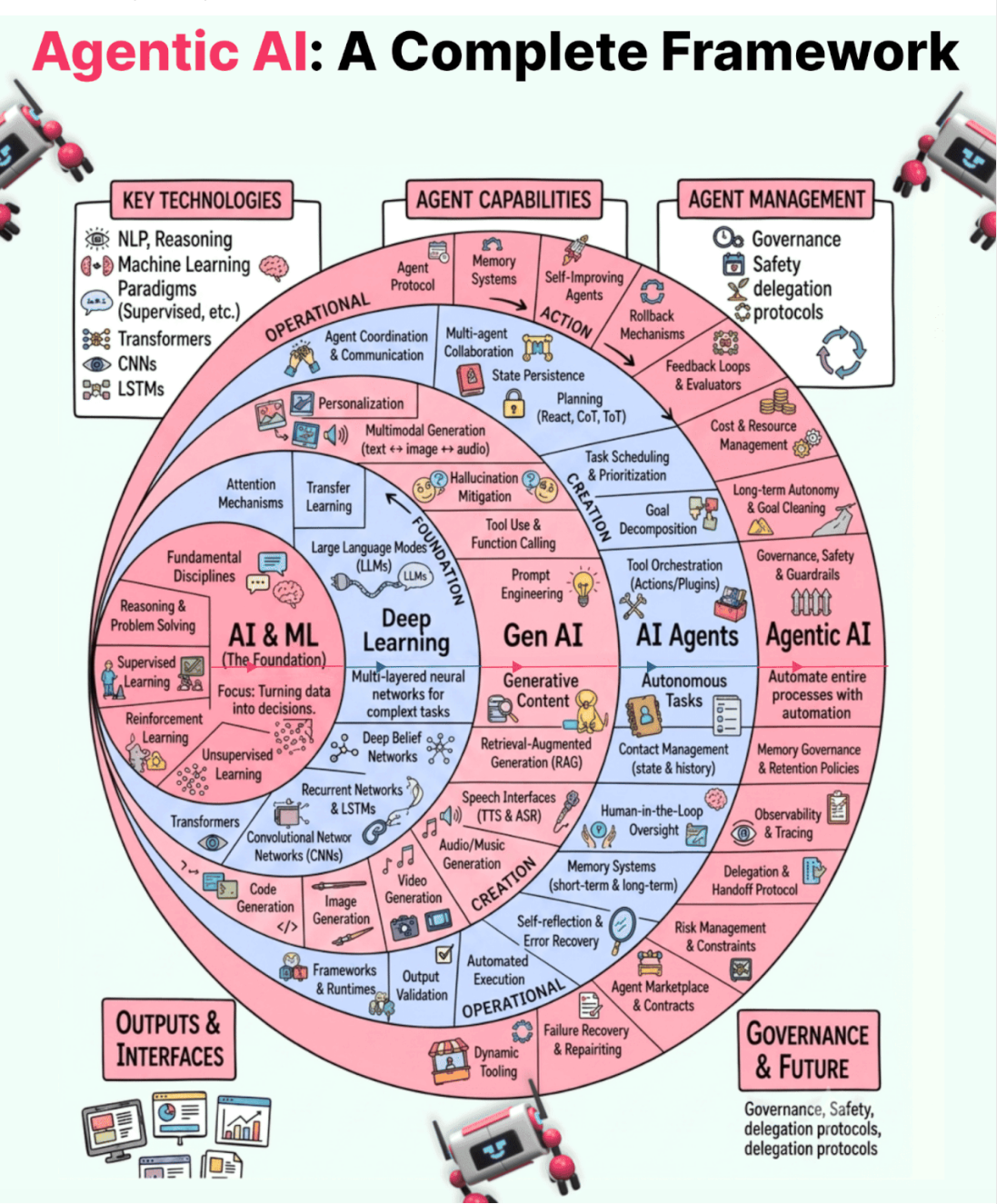
The diagram's core idea is a set of five nested layers, each one a superset of the last — the further out you go, the more autonomy and orchestration is stacked on top of the same underlying model capabilities:
| Layer | What it adds |
|---|---|
| AI & ML (the foundation) | Turning data into decisions — supervised, unsupervised, and reinforcement learning; the fundamental disciplines (reasoning, transformers, CNNs, LSTMs) everything above is built on. |
| Deep Learning | Multi-layered neural networks for complex tasks — attention mechanisms, transfer learning, large language models. |
| Gen AI | Generative content — prompt engineering, RAG, multimodal generation, hallucination mitigation. |
| AI Agents | Autonomous tasks — tool use/function calling, planning (ReAct, CoT, ToT), memory systems, human-in-the-loop oversight. |
| Agentic AI | Automating entire processes — multi-agent collaboration, delegation protocols, governance, safety, and guardrails. |
Cutting across those layers radially are four operational bands that repeat at every layer — the diagram's way of saying these concerns exist at every level of the stack, not just at the top:
| Band | Concerns |
|---|---|
| Foundation | Fundamental disciplines, LLMs, attention mechanisms, transfer learning |
| Creation | Prompt engineering, tool orchestration, goal decomposition, task scheduling |
| Action | Multi-agent collaboration, state persistence, planning, self-improving agents, rollback mechanisms |
| Operational | Coordination & communication, memory systems, failure recovery, cost & resource management |
Three side panels frame the whole diagram: Key Technologies (NLP, ML paradigms, transformers, CNNs, LSTMs) as the raw ingredients; Agent Capabilities (memory, self-improvement, rollback) as what an agent can actually do; and Agent Management (governance, safety, delegation protocols, feedback loops, cost management) as how you keep a fleet of agents accountable once they're running. Outputs & Interfaces and Governance & Future bookend the diagram — the former is where value leaves the system (dashboards, reports, charts), the latter is where risk has to be actively managed (retention policies, observability/tracing, delegation/handoff protocol, risk constraints).
Why this is worth keeping
It's a useful single-page mental model for a distinction that's easy to blur in conversation: Gen AI (a model that generates content on request) vs. AI Agents (a model that plans, uses tools, and persists state across steps) vs. Agentic AI (multiple agents coordinating to automate a whole process, with governance as a first-class concern, not an afterthought). The right-hand progression — from Agent Capabilities to Agent Management to Governance & Future — is effectively the same argument as the 4-phase AIGOV model on the AI Governance Framework page here: capability without governance doesn't scale safely, and the governance layer has to grow at the same rate as the autonomy layer.